Category Archives: Trucking

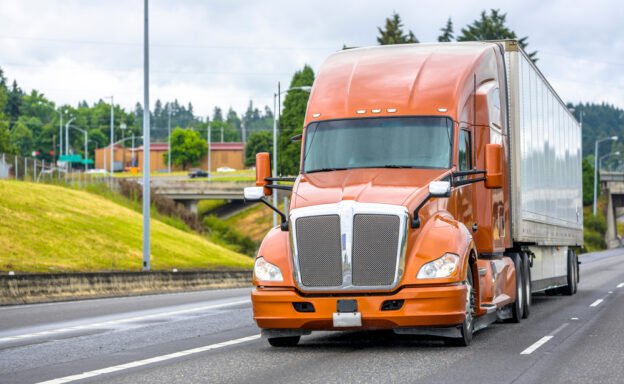
orange frieght truck

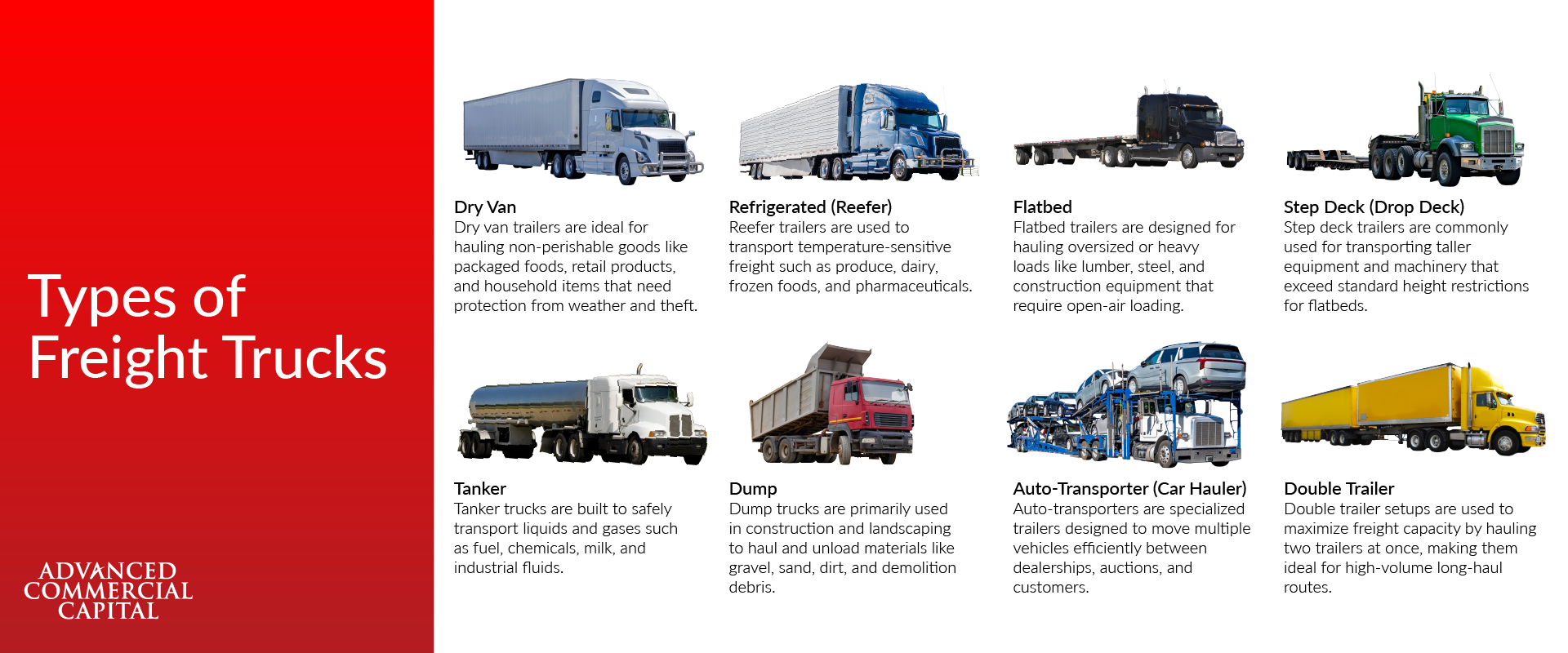
What are the Different Types of Freight Trucks?

What is a Freight Truck?

If you had to make a list of all the industries in this country that many people take for granted, transportation and logistics would undoubtedly be right at the top. Most of us don’t spend too much time thinking about the origins of that new furniture we bought, or that car, or all those items we ordered on Amazon. We just enjoy them. But without logistics professionals, they never would have made it into our lives.

In terms of the transportation industry itself, freight trucks are crucial. They’re designed to transport items safely and efficiently, no matter what. But obviously, different types of items have different requirements. You wouldn’t be able to haul gasoline to the local gas station for a refill using the same type of freight truck you would to get all those dairy items down to the local grocery store. You’d use freight trucks in both situations – just two different kinds.

When people talk about the sensitive nature of supply chain operations, not only in this country but around the world, understand that freight trucks of all shapes, sizes, and types are an integral part of that.

8 Types of Freight Trucks

All told freight trucks have a variety of intended purposes depending on what type you’re talking about. Some look very different from the next and many require specific types of experience to safely operate. They all have the same overall purpose, however: to make sure important items get where they need to be, no matter what.

1. Dry Van

A dry van is the type of freight truck that most people are familiar with. Indeed, if you’ve ever ridden on the highway for any appreciable length of time, you’ve likely passed more than a few of these. Dry vans have 53-foot-long trailers and are not temperature-controlled. If you’ve ever worked in a warehouse and had to unload pallets or even furniture, the chances are high that it all arrived at your destination via a dry van.

2. Refrigerated (Reefer)

Refrigerated trucks are sometimes called reefer trucks. They look similar to a traditional dry van, except the trailer itself is temperature-controlled. This makes it perfect for hauling items that need to stay within a precise temperature range, with food and beverages being the top example. Many pharmaceuticals and even sensitive chemicals are often hauled this way, too.

3. Flatbed

Flatbed trucks don’t carry their loads in an enclosed trailer. Instead, as the name implies, they use a flat, open trailer. There are no sides or even a roof. This is what makes them perfect for oversized cargo in particular. They’re easier to load than a traditional truck and can carry the type of weight that you’d be hard-pressed to match elsewhere.

4. Step Deck (Drop Deck)

Also commonly referred to as a drop deck, a step deck trailer is not too dissimilar to a flatbed truck. You still have a flat, open space with which to store items. However, the unique construction of a step deck makes it the ideal solution for tall cargo in particular. Not only do they have more overhead clearance, but they’re also easier to load and unload as well because they’re closer to the ground.

5. Tanker

Tanker trucks are designed very precisely to carry the types of loads that would largely be impossible to transport in any other way. A lot of construction materials make it to their destination this way – like sand or even concrete.

Here, there are two main types of tankers that you’re talking about. The first are dry bulk tankers, which can carry items like sugar and grain. Liquid tankers are also available, which are great for hauling beverages or even chemicals like gasoline. Most of these have different compartments to keep multiple loads separated from one another. They are both equally challenging to load and operate, albeit in their own unique ways.

6. Dump

Dump trailers, also commonly referred to as dump trucks, are designed to easily transport loose materials. One might be used to remove debris from a construction site, for example. Another might take essential materials like gravel to that same construction site. They’re also regularly used in the landscaping and agricultural sectors. The point is that whatever you’re hauling, you can do so quickly and efficiently. A dump truck is open on the top so whatever you’re hauling will be exposed to the elements to a certain extent, but that likely won’t matter.

7. Auto-Transporter (Car Hauler)

Auto-transporters are a type of freight truck designed for a single purpose: to safely carry multiple vehicles at one time. They’re built in a way that makes loading them easy – you essentially just drive the car right into an enclosed space, at which point it is secured. Depending on the size of the vehicles, it’s not unusual to see a car hauler with six or more cars at one time. These auto-transporters typically get used by car dealerships, for example, to transfer cars from one location to another. Regardless, if you need to transport vehicles over long distances, and you don’t want to actually drive them, an auto-transporter is likely how you’re going to get the job done.

8. Double Trailer

Finally, we arrive at double trailers. They’re essentially two dry trailers that are being pulled by a single truck. In terms of their design, think of them a bit like a train, only on the road. Multiple trailers are all being pulled via a locomotive, only in this case it’s a standard truck. You often see a lot of these carrying around large quantities of items in the retail or e-commerce industry. Some package delivery services also use them when they need to move high volumes of goods. Regardless, double trailers are understandably difficult to operate, which is why it takes an experienced driver to make sure things get where they’re going as safely and as efficiently as possible.

In the end, the type of freight truck you should use will vary depending on exactly what type of cargo you’re hauling. Typically, the job itself will dictate what type of truck is required. If something must be temperature controlled, you begin to narrow down your transportation options fairly quickly. If you’re having a hard time deciding, don’t worry – the team at Advanced Commercial Capital is happy to help.

If you’d like to find out more information about the different types of freight trucks, or if you’d just like to discuss your business’ own needs with someone in a bit more detail, please don’t hesitate to contact Advanced Commercial Capital today.

over the road trucker

Discover the World of Over the Road (OTR) Trucking

What is Over the Road (OTR) Trucking?

Also commonly referred to as OTR for short, over-the-road trucking is exactly what it sounds like. As a logistics professional, you’ll be tasked with hauling cargo over long distances, typically crossing state lines. You may even venture into other countries depending on the nature of the freight you’re carrying.

Over-the-road truck drivers can spend three to four weeks on the open road sometimes, seeing the best that Mother Nature has to offer while also making a satisfying living for themselves at the same time. They can sleep in either the cabin of their truck or at a nearby hotel or motel depending on their preferences.

Indeed, OTR truck driving professionals are the backbone of logistics in this country – they’re a significant contributor to the way our economy functions. But what is OTR in a general sense, and how does it differ from regional or even local truck driving? The answers to questions like those require you to keep a number of important things in mind.

How Much do Over the Road Truckers Make?

OTR (over the road) truckers typically earn between $45,000 to $70,000 per year, depending on factors such as experience, employer, and mileage driven. Some experienced truckers with specialized skills or hauling hazardous materials can earn upwards of $80,000 annually. Additionally, many OTR truckers receive benefits like health insurance, retirement plans, and performance bonuses, enhancing their overall compensation package.

OTR vs. Regional vs. Local Trucking

It’s entirely possible for over-the-road, regional, and local truck drivers to be carrying similar types of freight at a given time. It’s just that beyond this, the nature of their job (and the length of each commitment) can vary wildly.

Local trucking is exactly that – short-range trucking that likely involves hauling cargo from one part of a city to another. Most of these truck drivers work a typical 9-to-5 work day, or at the very least have something that resembles a traditional hourly job. A local truck driver might pick up a load of goods at a warehouse and take it to a specific business, for example. They’ll also likely drive smaller trucks simply due to the nature of their job.

Regional truck driving kicks things up a notch by breaking free of the confines of one particular area. Here, truck drivers will travel an entire region which can involve multiple states depending on the logistics network someone is a part of.

Most larger organizations that do a lot of shipping break the country up into a series of smaller states. Each of those collections of states is called a region and a regional truck driver could find themselves in various locations across the Northeast, Midwest, Southwest, or more depending on the day.

Regional truck driving is a bit more time-consuming and labor-intensive than local truck driving, but not nearly to the extent that OTR trucking is. Regional truck drivers could be engaged in one job for a few days at a time, but they’ll still get to spend more time with their friends and family members than their OTR counterparts. They regularly find themselves away from home, but never too far away from home.

As stated. OTR truck drivers can find themselves on-the-road for literally weeks at a time. It’s not inconceivable that they could have to haul a load from one corner of the country to another, or from Washington state across the border into Mexico. It all depends on who they’re working for and what the needs of the job are. Anywhere you can get to on the continent via truck is a place that an OTR truck driver could find themselves in at some point.

OTR Trucking Job Requirements

An OTR Trucker driving away from the sunset.
The number one OTR trucking job requirement to concern yourself with has to do with a CDL, or commercial driver’s license. Just like you need a driver’s license to operate your personal motor vehicle to show that you have the skills and judgment necessary to do so safely, the same is true of commercial trucks.

There are three main classes of CDL to choose from depending on your needs. These include:

  • Class A, which is the most common. This lets people operate vehicles with a combination weight rating of 26,001+ pounds. Examples of things that would fall under that category include tanker trailers, tractor trailers, and flatbed trucks.
  • Class B, which is necessary if you’re planning on operating a single commercial motor vehicle that is NOT hitched to a trailer. Here, you’d be talking about something like a school bus or a larger delivery truck.
  • Class C, which is essentially a Class B license only it also gives you the ability to tow another vehicle that weighs less than 10,000 pounds. The combined weight cannot exceed 26,001 pounds, however. Many tank trucks meet this description.

  • It’s also important to note that the actual licensing process you’ll go through varies depending on which state you’re in. They all, at a minimum, will require you to take both a written test and a practical one. To that end, it will be not unlike when you got your regular driver’s license as a teenager, albeit on a much larger scale.

    In an over-arching sense, you’ll always have to prove that you’re capable of safely operating the vehicle that you’ll be driving and that you’re capable of adhering to state and federal regulations. It’s just that some states are a bit more intense when it comes to proving exactly that.

    Advantages of OTR Trucking

    By far, one of the biggest advantages that comes with OTR trucking has to do with earnings potential. Yes, it’s a significant time commitment, and you’re almost guaranteed to spend a lot of time away from your friends and family members. But according to one recent study, the average starting salary for drivers is about $64,000 per year. Depending on the amount of experience you have, coupled with certain endorsements, you could easily make $120,000 or more.

    All this and you also have more job security than most people get to enjoy. Right now, there is actually a truck driver shortage in this country – a problem that is only expected to get worse as time goes on. Over the next decade companies will be so desperate for truck drivers that you essentially never have to worry about being out of work for too long. You’ll also likely get perks like a fuel card while over the road trucking so you don’t have to worry about how you’re going to get from one location to another.

    Many people also enjoy the fact that there are few requirements needed in order to begin a career (only the aforementioned licensing), and professionals often cite the decidedly unique lifestyle they get to live as a major selling point.

    If you’re interested in finding out more information about over-the-road truck driving and why it might be an ideal career choice for you, or if you just have any additional questions that you’d like to discuss with someone in a bit more detail, please don’t delay – contact the team at Advanced Commercial Capital today.
    Freight manager revewing LTL freight route

    What is LTL Frieght?

    Understanding LTL Freight

    Less than truckload freight, also commonly referred to as LTL for short, is exactly what it sounds like — the process of transporting products and other goods that don’t necessitate a full tractor-trailer or other large commercial truck to do so.

    Because of this configuration, one business may share space with others during transportation. They will pay only for the space their pallets are using, at which point the remainder of the truck will be filled up with assets relating to other businesses. Usually, these LTL freight shipments can range from between 150 pounds to 10,000 pounds, although there may be some exceptions.

    Weighing the Pros and Cons of LTL Freight

    As is true with any type of shipping, LTL freight has both its advantages and disadvantages. Only by understanding the intricacies of each will you be able to determine which approach is most appropriate for your needs.

    Advantages

    The most immediate benefit of LTL freight has to do with cost savings. It’s simply far cheaper to pay for a portion of the space on a truck than it is for the entirety of the vehicle. Depending on what you’re shipping, LTL could wind up being exponentially less than what you would otherwise pay.

    Because of this, LTL freight is notorious for being small business-friendly in particular. Smaller organizations don’t necessarily have the available funds necessary for full truckload freight. If what they’re shipping doesn’t take up enough physical space to actually require that full truckload, they’re also paying for resources that they’re not utilizing. So not only does LTL freight become the more cost-effective option, but the most efficient one as well.

    LTL freight by design is also very environmentally friendly. Due to things like fuel costs, it’s unrealistic to ship a truck with anything less than maximum capacity — especially if it’s going to be traveling large distances. Rather than having five businesses pay for five separate trucks that they won’t be utilizing 100% of, all that can be condensed into a single shipment — creating a beneficial situation for all parties.

    Disadvantages

    Of course, that’s not to say that LTL freight isn’t without its potential obstacles — chief among them being the added time that it adds to the shipping process.

    If a business was paying for a full truckload, that driver would answer exclusively to them. It would pick up those products and head right to their final destination as quickly as possible. With LTL freight, you are sharing space with other businesses that will also need to be attended to. This could cause an appreciable delay in the amount of time it takes for a shipment to reach its destination.

    LTL shipping is also inherently complicated due to the ever-fluctuating rates that organizations are charged. It isn’t just your shipment’s destination that carriers are concerned about. They also want to know the total weight, the pickup location, the deadline, and other factors. Everything impacts how much you will pay, which can make it a time-consuming process in and of itself to determine how much you’ll spend and where to go to find the perfect balance between price and the level of service you get in return.

    Navigating LTL Freight Rates

    As stated, a number of different factors determine the LTL shipping rate that you’ll pay. The dimensions of your shipment determine the class itself, which impacts — but does not totally dictate — the rate. The destination of the shipment will also play a role. The farther it has to go, the more money you can expect to spend.

    Some shipments require special handling, which will also add to the cost. Examples include but are not limited to perishable items, fragile items, and anything that is particularly hazardous. Finally, if you choose to expedite your shipment, you can expect to pay an additional fee.

    Optimizing LTL Freight Management

    One of the best ways to optimize your LTL freight management efforts involves the use of a transportation management system, otherwise known as a TMS for short. This is a software-based tool that not only provides shipping optimization on a case-by-case basis, but also global visibility and business intelligence into everything that you have in transit.

    Once all information is entered accurately, a TMS will be able to consider every LTL load you have in the context of your entire business. It can then help you identify opportunities to combine with other loads on nearby routes. It can also help you select an LTL carrier, better anticipate your rates, and more — all so that you can have the most complete and accurate picture to work from when making decisions.

    Choosing Between LTL and Parcel Shipping

    Generally speaking, LTL shipping is ideal for organizations that A) do not require a full trailer to transport their items, and B) are dealing with a shipment that is under 15,000 pounds. Any more than that and you would obviously want a full trailer. Any less than that and LTL still might be a bit too much effort given what you’re trying to accomplish.

    Depending on current freight rates, parcel shipping might be the way to go. This is especially true if the items you’re shipping are under 150 pounds individually. In that case, you’d probably be able to find more competitive rates with a parcel service.

    Addressing Common Issues in LTL Shipping

    One of the most common issues that businesses often face with LTL shipping has to do with misunderstood shipping windows. When your average person buys a product online that is shipped to their home, they’re very used to “three-day shipping” translating to “three days or less.” When you’re talking about large, complex situations involving LTL freight, a quote of “three days” likely means a “minimum of three days.” Because of that, you need to calibrate your own expectations accordingly and make appropriate arrangements with your customers or those waiting for your shipments.

    Another common issue that many have with LTL shipping has to do with rates that seem to fluctuate far more than they really are. If you’re getting a quote based on inaccurate information, that quote will be adjusted appropriately once the carrier actually has possession of your shipment.

    For the best results, always weigh and measure as accurately as possible. If a product weighs 10 pounds, but it’s in a box with a lot of empty space, that’s a lot of wasted room that will only add to your costs. Try to package things as carefully as you can to avoid running into these types of problems moving forward.

    To find out more information about the ins and outs of LTL freight, or to get answers to any other questions about the process that you may have, please don’t delay — contact Advanced Commercial Capital today.

    An Asian male truck driver using his radio to communicate - using trucker lingo, trucker slang

    A Complete Guide to Tucker Lingo and Radio Codes

    The Origins of Trucker Slang

    When you’re a truck driver communicating on the open road, you’re using radio frequencies that a lot of other people rely on at the same time. Because of that, the number one rule is to never use more airtime than you absolutely need. Out of this simple idea, an entire dictionary of trucker slang was born.

    Trucker slang is a vocabulary developed by truckers on CB radios in the 1970s and 1980s. It saves time while still getting across important information about upcoming hazardous road conditions, a police presence, and other things that truckers need to be aware of while driving. Many phrases that are now common (like a person calling someone else’s spouse their “better half”) originated from what was essentially this new language that truckers slowly developed out of necessity.

    10 Must-Know Trucker Terms for Beginners

    While there are a seemingly endless number of examples of trucker slang out there, ten terms in particular are so common that it’s practically mandatory that you know them. Understanding what they mean (and critically, the context in which they’re used) is the key to having a successful, productive conversation while on the open road.

    1. All Locked Up. This term is commonly used when one trucker warns those on the road behind him that an upcoming weight station is closed.

    2. Alligator. Sometimes you’ll see this expression itself abbreviated as “gator.” It means that there are upcoming dangerous conditions on the road that truckers need to be mindful of. A piece of tire in the center of a highway could damage a truck’s hose or body, for example. Or, it could get kicked up and damage a nearby car. The term comes from the idea that you shouldn’t let it “bite you.”

    3. Back It Down. This is something one trucker will say to another when they’re warning them to slow their speed. There may be a police officer coming up, or traffic may be getting hazardous for some reason.

    4. Bear In the Bushes. This means that not only is there a police officer on the road up ahead, but he or she is also hiding just out of normal view. They’re probably trying to catch people who are speeding using the element of surprise.

    5. “Do What?” When a trucker says something that doesn’t quite go out properly over the radio, another trucker might say “do what?” as a quick way to get them to repeat themselves.

    6. Good Neighbor. If one trucker does something that you find helpful or that you approve of, you would show your appreciation by saying “thanks, good neighbor.”

    7. Gumball Machine. This is yet another of the many examples of trucker slang relating to law enforcement. Here, one trucker is warning others that they see patrol car lights on the road ahead.

    8. Home 20. A trucker would ask for your “Home 20” as a way to find out what your home location is.

    9. In Your Back Pocket. A location is already “in your back pocket” if you have previously passed it on the road.

    10. Roger. This is just another term for saying “yes,” “affirmative,” “okay,” or any other similar form of acknowledgment.

    CB Radio Codes

    Also commonly referred to as a “citizens band” radio, a CB radio is a type of tool that was commonly used by truckers to stay in communication with one another while on-the-road. Nowadays, wireless communication is practically ubiquitous – people have cell phones, messaging apps, industry-specific social networking tools, etc.

    But for decades, when one trucker wanted to warn another about an impending road hazard, or to ask a question, or just to hold a conversation to stave off the boredom, they would use a CB radio in order to do it.
    CB radio codes were developed as a type of shorthand to quickly convey an idea or a critical piece of information to others. Going beyond trucker slang like those examples outlined above, 10 codes are typically employed. This is a fast, efficient way to universally communicate ideas like:

    1. 10-1. You would say this if you can’t hear another person you’re trying to communicate with.

    2. 10-2. This means that you can hear other people clearly.

    3. 10-3. This means that you want someone else to stop transmitting for whatever reason.

    4. 10-4. This is a widely known expression that simply means “message received.”

    5. 10-6. This means that you’re busy and that someone should hold on a moment before attempting to speak.

    6. 10-9. You would use this 10 code when you want someone to repeat whatever it is that they just said.

    7. 10-10. You would use this at the end of your transmission to let other people know that you’re done talking.

    8. 10-17. You would preface a message with this, letting people know that whatever you’re about to say is urgent.

    9. 10-20. You ask someone for their “20” if you are trying to find out what their exact location is.

    10. 10-33. You would use this to let people know when there was emergency traffic at a station.

    11. 10-45. You would say this if you wanted everyone within the broadcast range of your radio to report their status.

    12. 10-100. This is the 10 code that means you’re taking a bathroom break.

    Common Expressions

    In addition to the CB 10 codes outlined above, there are a number of common expressions that you’re likely to hear on the radio. When talking about CB slang in particular, however, they take on a slightly different meaning than general trucker slang.

    1. Ace. Someone would be referred to as “ace” if they are an important CB operator.

    2. Ancient Mariner. A reference to classical literature, The Rime of the Ancient Mariner, this is used to describe someone who is an AM or FM user.

    3. Beam. This is another way to refer to a directional antenna.

    4. Big Mama. This term describes a 9-foot whip antenna.

    5. Double Key. This phrase describes when two stations are talking at the same time.

    6. Fox Charlie Charlie. This is another way to describe the FCC.

    7. Fox Hunt. When the FCC is actively searching for illegal operators, this is called a Fox Hunt.

    8. Haircut Palace. Someone would warn another driver about a bridge or overpass with a low clearance by calling it a “Haircut Palace.”

    9. Twin Huskies. This is a term used to describe someone using dual antennas.

    If you’d like to find out more information about trucker lingo and the types of radio codes that are commonly used on the open road today, or if you just have any additional questions that you’d like to go over with someone in a bit more detail, please don’t hesitate to contact the team at Advanced Commercial Capital today.
    A White Truck on a City Street that was dispatched by a Freight Broker

    How to Get Loads for Your Trucking Business

    Finding fresh loads is a constant hustle and sometimes a hassle for both truckers and trucking companies. But rest assured, with a shortage of truck drivers in the US; there are plenty of loads out there to source.

    Whether you’re just starting to haul or have been moving goods for years, there are ways of finding new loads that are cost-effective and make doing business easier.

    We will look at how to get loads for trucks and how to keep a steady flow of work coming your way.

    Building a Strong Network of Clients and Partners

    Networking is the backbone of established trucking companies. It can be time-consuming and hard to break through when branching out as an independent truck driver.

    But building a solid network with clients and partners is beneficial and has a high payout over time.

    Get involved with truck industry associations by going to events that focus on the types of freight that you are looking to haul. Some associations are exclusive and only allow entry if you work in their specific industry.

    Keep in mind that trucking associates are not the place to find clients and are attended mainly by your potential competitors.

    However, industry events are a great place to shake hands, exchange tips, and in some cases, build a prospect list.

    Utilizing Online Load Boards and Freight Marketplaces

    Load boards were once found on special television screens at most truck stops in the US. Now, you can easily find pick-up and drop-off locations, rates, and contact information all online.

    You can find free online load boards, while others have paid options. Some load boards offer free trials and even have easy-to-access apps that send notifications about newly posted fresh loads.

    Freight marketplaces and online load boards have the same basic function of connecting shippers, brokers, and carriers of shipments. But, a freight marketplace offers more services and is more comprehensive than a load board.

    Online freight marketplaces use a load-matching algorithm to help shippers and brokers find suitable carriers for the job.

    Developing Effective Marketing and Branding Strategies

    You don’t have to be a million-dollar trucking company to develop an effective marking and branding strategy.

    Organic social media content is an easy, cost-effective way to generate new business and build a reputation. When you post regularly, you’re putting your name out there and interacting with the shipping community. Just remain authentic to your brand and open to experimenting on different platforms.

    Websites are great tools for spreading the word, but you want them to make a strong impression. One effective strategy is to work with an SEO professional to optimize keyword search and link building.

    And we can’t forget truck wraps. A large vinyl decal can display your name, number, and an impressionable logo for thousands of people to see each day.

    Maximizing Efficiency through Route Planning and Load Optimization

    Load planning is about maximizing the capacity of you and your truck so that you can deliver multiple shipments in the fewest trips. But there are things you must consider your truck’s specifications (refrigerated), the center of gravity, where it’s going, and the product you’re hauling.

    The main responsibility of a load planner is to maximize payload capacity. It also cuts unnecessary costs by considering loading sequence, destinations, overtime, and more.

    Efficient route planning improves customer satisfaction because you can deliver goods on time, every time. It provides you with accurate time window management, real-time updates, effective other fulfillment, and services that focus on the customer’s preferences.

    Using route planning and load optimization ensures better safety for drivers. It takes into account road conditions and road limits and helps you avoid high-risk areas. And when optimizing routes, you’re reducing fuel use and truck emissions, which lessens the environmental impact.

    Maximizing efficiency through route planning and load optimization ensures that you’re complying with new trucking regulations. Manually planning and sequencing routes are inefficient, time-consuming, and leave too much room for errors.

    Leveraging Technology and Automation for Streamlined Operations

    In the trucking industry, technology is ever-evolving. Technological advancements and software solutions help streamline operations, reduce costs, and optimize overall performance.

    Trucking companies and some owner-operators use fleet management software to track insights into vehicle locations, routes, fuel consumption, and maintenance schedules.

    Electronic Logging Devices (ELDs) have changed how large-fleet trucking businesses and owner-operators track and manage hours of service (HOS) to remain compliant.

    Using a telematics system to track performance allows you to monitor speed, fuel consumption, braking patterns, and more to optimize fuel efficiency and address any maintenance issues faster.

    Advanced analytics and predictive maintenance is another maintenance solution that proactively addresses maintenance issues and minimizes truck downtime and repair costs.

    The evolution of automation using mobile applications has changed how the trucking industry does everything from GPS tracking to load management. Mobile apps streamline operations, reduce time-consuming tasks, and enhance overall productivity.

    Conclusion

    You have options when you’re in search of fresh loads to transport.

    Building a solid network of peers allows you to establish yourself in the trucking business as an owner-operator. And developing effective marketing and branding keeps your name out there.

    Technology and the internet now allow trucking companies and independent contractors to access load boards and freight marketplaces from anywhere, maximize efficiency, and automate to streamline services.

    Route planning and optimization come with plenty of advantages, including cost reduction, enhanced efficiency, better customer service, and more.

    But understanding how to get loads for trucks is not the only way to increase cash flow and stay profitable. Saving money, improving cash flow, and remaining consistently profitable continues after you have picked up and dropped off a load.

    We at Advanced Commercial Capital understand the things that truckers need to feel confident and succeed. We provide custom-tailored, fair and honest invoice factoringthat protects you against unpaid invoices due to fraud, bankruptcy, or delinquency.

    You can contact us at Advanced Commercial Capital at 855-465-4655 or by using our contact form.

    Trucking Key Performance Indicators

    A blonde, female truck driver stands in front of a row of semi trucks, she is wearing a blue flannel with a red puffer vest, with her arms crossed, she's smiling knowing that she has solid data and information to increase the kpi for trucking companies

    A Key Performance Indicator (KPI) for trucking companies is a metric that tells the staff more about how their operations are helping or hurting their bottom line. Known as Key Performance Indicators due to their unmistakable importance to an organization’s longevity, truckers need to pay attention both to what their KPIs are and how they change over time. Advanced Commercial Capital provides factoring for companies that prefer to have timely cash flow, which is why we encourage everyone to get a handle on how they work.

    Cost Per Mile

    How many miles a truck drives is easy to calculate, though most truck companies will break it up into loaded and dead-head categories. The loaded miles are known as those where the truck is carrying cargo, while the dead-head category refers to the return journeys. Clearly, the cost of loaded miles can vary throughout the journey, depending on whether the truck has multiple stops. (The tail end of a journey may not carry the same costs as those at the beginning, but it will have an effect on your total profits.) Dividing miles may not always be perfectly precise, but there needs to be a solid estimation as a jumping-off point for future calculations.

    Gross Profit Margins

    A gross profit margin refers to how much the company makes after deducting straight costs, like wages, maintenance, and fuel. Net profit margins refer to how much the company makes after deducting all expenses, which can include anything from annual taxes to business insurance. Assessing a gross profit margin comes down to having all of the right numbers, so it’s important to think about how much is spent at any given time on standard expenses. For instance, if you service all trucks at one time during the year, you can average out the costs to get a better idea of your gross profits per month.

    Driver Turnover Rate

    Driver turnover can often cost companies more than they realize. It’s not merely the cost of posting a job ad or calculating the amount in wages it takes to sort through the applications, run the interview process, etc. When one driver leaves, all of their training goes with them. If they had any relationships built up along the way, those bridges may be burned too. Though an extremely important KPI for trucking companies, the full costs of turnover rates aren’t always apparent until after a company gets into financial trouble.

    While you’re considering the turnover rates, you should also think about employee satisfaction as a whole. The more happy and engaged employees are, the more productive they’ll be. If you’ve noticed that workers are ‘checked out’ to a certain extent, it may be worth more to incentivize them than it is to ignore the issue.

    Safety Performance

    Trucks are on the road day after day, so their safety performance will have a lot to do with how much every trip will make. When it comes to safety, ‘almost’ certainly does count. The more near-misses on the road, the more likely it is that the driver will have a mishap in the near future. Truckers may feel like they’re in unwinnable situations when it comes to their livelihoods: they have to be well-rested enough to function, yet they won’t make any money if they’re not on the road.

    Careless drivers may be a great way to bolster short-term revenue for all involved but, overall, it’s a losing strategy. Improving this metric may involve anything from holding a one-time defensive driving class to entirely revamping the schedules of drivers. It seems like too much effort is being put into this one KPI for trucking companies, just consider what a single lawsuit would cost.

    Freight Claim

    It’s impossible to prevent every potential snag on the road when it comes to cargo. Sometimes the truck tilts at just the right angle in a way that could never have been predicted. However a company settles damage or loss to goods incurred on its trucks, though freight claims can cost trucking companies quite a bit if they’re not careful. Drivers are not always diligent when it comes to loading and counting their freight, and brokers and shippers are well aware of this. Pre-trip inspections, supervised loading, official reports, photos, well-stacked freight, and better driving can all go a long way when it comes to improving this KPI for trucking companies.

    Equipment Utilization

    Equipment refers to your trucks, but it can also refer to any ancillary gear (e.g., dollies, straps, etc.) used to make the treks. Like many of the other KPIs listed here, there’s not always an easy way to determine the exact degree of wear and tear. For instance, if a driver is particularly hard on their brakes, this may not come to anyone’s attention until the brakes start to squeak (or, worse, when they start to lose their potency). The best way for truckers to measure this KPI is to look at their past records for spending trends. It’s likely that repair or replacement costs are worse for certain categories than others, which can give decision makers a better idea of whether the business can get more value from each asset.

    KPIs and Cash Flow

    Trucking companies don’t always boast the highest profit margins, but there is a good degree of wiggle room between the highs and lows. The best trucking companies are ones that operate with a keen eye on how their resources are being spent on any given day. They see not only how their short-term expenses are costing the company, but what can be done in the long-term to rein in their budget.

    At Advanced Commercial Capital, our job is to get trucking companies the money they need to pay their staff, bring in new clients, and complete all maintenance on time. From fuel to insurance, we specialize in transportation factoring because we know how important it is for our clients to have someone to call. To learn more about our services, which do not include long-term contracts or setup fees, contact us today.

    The Definition & Dangers of Double Brokering

    two people shake hands after conducting business, successfully avoiding double brokering

    At Advanced Commercial Capital, we’re proud of the reputation we’ve been able to earn over the years as an industry leader in terms of factoring for trucking companies. With over 100 years of combined experience, our team wants to become a partner in every sense of the term – one that is every bit as invested in the ongoing success of your business as you are.

    In addition to helping with things like common truck factoring rates, we also want to help shed light on topics that are important to the industry. Case in point: double brokering. What is it, is it considered illegal, and how could it potentially harm your company negatively moving forward? The answers to those questions require you to keep several key things in mind.

    What is Double Brokering?

    At its core, it is a practice that involves a shipper who provides freight to a freight broker under the assumption that said broker will then pass the freight along to a carrier, who will then haul everything to where it needs to go. What can happen, however, is that the broker passes the freight onto a carrier then who re-brokers the freight, either on their own or through another broker, without informing the shipper or getting permission to do this in any way. Depending on the complexity of the situation, double brokering can involve two, three, or more carriers and brokers at a time.

    Part of what makes this such a bad situation has to do with what is largely considered to be criminal intent. Yes, it’s entirely possible that a carrier may mistakenly assign a shipment to multiple brokers due to an “innocent mistake” or “misunderstanding.” But more often than not, a load is accepted by a company that has no intention of actually hauling it. Instead, they find another trucking company willing to do the job at a lower rate than their contracted rate, allowing them to keep the difference, or worse, not pay the hauling carrier at all.

    Note that this is not the same thing as co-brokering. This, too, is a situation where multiple brokers are involved in the transportation of freight. However, the fee for the entire task is split among all parties involved in a way that they all A) know about, and B) have agreed upon.

    Is Double Brokering Illegal?

    The answer to this question largely depends on the form of double brokering that you’re dealing with.

    Due to many of the reasons outlined below, acting as an intermediary for a load without criminal intent isn’t expressly illegal – however, it is highly frowned upon and it is definitely not recommended by any legitimate company.

    The type of double-dealing that is illegal, on the other hand, involves a situation where a broker or carrier accepts payment for a shipment, then fails to provide any type of payment to the carrier that actually hauled the freight.

    This type of deal in particular is considered to be “theft of services” and can lead to not only significant fines but potentially jail time as well.

    Engaging in the act of accepting payment for a shipment and then failing to provide compensation to the carrier who transported the freight where all parties involved do end up getting paid is not technically illegal. However, virtually everyone disapproves of it, and with good reason.

    How to Avoid Being Double-Crossed by a Double Broker

    1. Perform due diligence on all brokers. Call to check the credit of brokers. Look for variations in broker name, location, contact information, and billing information. Often these fraudulent brokers alter the documents they receive from actual carriers to convince victims that they are a part of a legitimate company.
    2. Verify a carrier’s information with their Department of Transportation registration. If the phone number and address don’t match the information you’re given, that’s a big red flag.
    3. Double check the broker’s rate. Use common sense and apply the old adage, “if it sounds too good to be true, it probably is.” A scammer posing as a carrier may accept a load for much less than the going rate to entice a broker into taking the deal. Or, a scammer may offer a carrier more money than originally offered by a broker to take advantage of someone who needs a quick payday.
    4. Be aware of timing. Deals posted late in the week or at the end of the day are frequently made by fraudulent brokers. Why? Because they’re preying on truckers’ worries over not being able to schedule a load by a certain time. And anytime a broker seems in a rush to get you to agree, you should also be wary.
    5. Check their Authority to Operate. Search FMCSA’s Safer and Fitness Electronic Records system website, https://safer.fmcsa.dot.gov/ to make sure the DOT/MC authority to operate number matches with what the carrier has submitted

    How Does Double Brokering Hurt a Company?

    Double brokering can hurt the original company shipping the freight primarily because they’re losing visibility into what is already an inherently flexible process. Their goods have changed hands to the point where they are no longer aware of who is in possession of it or who is responsible for seeing them through to their intended destination.

    From their perspective, this could lead to shipments that are significantly delayed with no real explanation as to why. This could also result in delayed or even missed payments from their own clients and vendors as well – causing major cash flow issues in a situation where they probably can’t afford to deal with such a problem.

    Dangers of Double Brokering

    All told, this practice is dangerous in a number of different ways, both literally and figuratively.

    Legal Liability

    Perhaps the most pressing risk of engaging in such conduct is the potential for legal responsibility. If a carrier is in possession of double-brokered freight and gets into an accident, for example, virtually no insurance company will approve a claim that has been made due to the circumstances. This is true regardless of your pre-existing relationship with that provider.

    Financial Loss

    Financial loss is a major risk that can arise when there is a breach of trust between parties involved in transportation arrangements.

    Whether a carrier knowingly or unknowingly accepts a load that has been double-brokered, there is a high chance that they might not actually be paid once the job is done. Even if there is no criminal intent on behalf of the company doing the double brokering, this could still happen. If the company receiving the freight files a dispute due to goods having been damaged in transit or delivered late, for example, at best it will significantly delay that carrier’s ability to get paid, and at worst they won’t see any money for the job at all.

    This is if they aren’t inadvertently dealing with a fraudulent broker who simply disappears after the freight has changed hands.

    Service Quality

    Naturally, a major danger of double brokering has to do with a significantly diminished service quality. The more parties are involved in shipping, the more opportunity there is for something to go wrong. Likewise, from the point of view of the original company doing the shipping, just because you trust the first company doesn’t mean that you can trust whoever they end up double brokering your freight to. You have no idea of this company’s reputation or credentials – if you’re even aware that they’re in the mix at all.

    Reputation

    Finally, double brokering comes with significant reputational risks for all involved. Because this practice is, at the very least, frowned upon (and often illegal as outlined above), it could lead to the potential cancellation of a company’s FMCSA authority or it could have them entirely blacklisted with reputable organizations like shippers and other brokers in the industry.

    If you’d like to find out more information about the inherent dangers of double brokering, or if you have any additional questions that you’d like to get more specific answers to while talking to an expert, please don’t hesitate to contact the team at Advanced Commercial Capital today.
    Fuel card vs. credit card

    Fuel Card vs. Credit Card: What’s the Difference?

    With over 2 million truck drivers in the U.S. alone, it’s no surprise that companies are looking for ways to save money when managing their fleets. One question they ask is whether to use a fuel card or a credit card. When it comes to managing the finances of a trucking business, there’s often confusion between fuel card vs credit card. It’s important to understand the differences between these two payment methods to make an informed decision when selecting one for your business.

    Whether you’re a fleet manager or a truck driver, here are some key differences to consider when deciding between fuel and credit cards. Fuel cards are specifically designed for use at fueling stations and provide access to discounted fuel prices and other features that can help reduce costs associated with running a trucking operation. Credit cards offer more flexibility but have higher fees and interest rates. In this article, we’ll look at fuel card vs credit card comparison so you can determine which is best suited for your needs.

    What is a Fuel Card?

    A fuel card is a payment card issued by commercial fueling companies that allows businesses to purchase fuel from participating service stations. It can also be used to pay for other services such as car washes, lubricants, and maintenance. Fuel cards offer a convenient way to manage your company’s fuel expenses and can provide discounts on fuel purchases.

    To improve efficiency and cost-effectiveness, businesses can assign fuel cards to individual drivers or fleets of vehicles. This allows you to track the quantity and type of fuel purchased and the cost of each purchase. Fuel cards are also useful for identifying fraud or unauthorized purchases. They provide detailed reports of purchase activity that can be used for auditing or expense management.

    Fuel cards offer many benefits for businesses, including discounts on fuel, convenience, and the ability to track and manage expenses. If you are considering using a fuel card, compare the features and fees of different providers to ensure you get the best deal. A fuel card can effectively reduce costs and maximize savings with careful monitoring and management.

    What is a Credit Card?

    A credit card is a payment card that allows you to make purchases without using cash. It enables you to borrow money from the credit issuer to make purchases, and then you can pay off the balance over time with regular payments (called minimum monthly payments). Credit cards also often offer rewards and cashback when you use them for certain purchases.

    A credit card is like a loan for a business, but with much less paperwork and an easier approval process. You can use your credit card to make purchases or withdraw cash from ATMs, and it’s often more convenient than using a check or cash. Plus, credit cards are accepted almost everywhere, so you can use them to make purchases worldwide.

    What are the Differences?

    A blue fuel card

    When it comes to fuel cards and credit cards, there are some key differences that truck owners should be aware of. They include:

    Fuel Discounts

    A fuel card comes with various discounts, making it an incredibly attractive option for truck owners. With a fuel card, you can benefit from discounts on fuel purchases, meaning you can make the most of your money. Some cards also offer rebates to get a percentage back on fuel bills. You’ll also get discounts on other essential items like lubricants, spare parts, and tires from participating partners. You won’t get the same discounts or rebates with a credit card.

    Fuel Tracking

    With a fuel card, you can track and monitor your fuel purchases. You can see where and when each purchase was made, what kind and quantity of fuel was purchased, and other details. This makes it easier to stay on top of your fuel expenses, which can be incredibly helpful for budgeting, tax season, and more. You don’t have that kind of insight into your expenses with a credit card. Instead, you get a bill at the end of the month with no easy way to track your fuel purchases.

    Security and Fraud Protection

    Fuel cards offer security and fraud protection layers that help business owners keep their funds safe. Unlike credit cards, fuel cards have a range of anti-theft and fraud prevention features, such as PIN authentication and driver identification. Additionally, fuel cards are associated with an account that only has enough funds for fuel and transportation-related expenses, reducing the risk of fraud compared to a credit card that can be used for any purchase. Combining these features helps ensure that fuel card users can enjoy secure transactions.

    Do Companies Prefer a Fuel Card or Credit Card?

    According to a report by Allied Market Research, the fuel card market has grown exponentially over the past few years, and it’s no surprise that many companies are taking advantage of these benefits. Fuel cards can be incredibly helpful for trucking businesses, providing discounts on fuel, detailed tracking of purchases, and enhanced security to protect against fraud. Fuel cards offer more advantages than credit cards for businesses looking to manage their transportation or fuel costs. Fuel cards give companies greater visibility and control over their drivers’ purchases, with data that can be tracked and reported on.

    Fuel cards are also typically more secure than credit cards, as they typically don’t require personal information to be used; this makes them less vulnerable to fraud. As a bonus, fuel cards often come with discounts to help companies save on fuel costs. On the other hand, credit cards may offer traditional reward points, but they often come with higher interest rates and fees.

    Conclusion

    Choosing between a fuel card and a credit card is an important decision for trucking companies. A fuel card can provide multiple financial benefits when used responsibly and offers significant convenience for refueling and payment processing. It also helps maintain better control over your account while providing you with key data to help send rate confirmation, manage fuel costs, optimize routes, and maintain reasonable budgets. On the other hand, credit cards certainly have their place but tend to come with high fees and interest rates, which can quickly add up for commercial truckers.
    At Advanced Commercial Capital, we understand the needs of truckers when it comes to cash flow and want you to succeed with your business. We provide trucking companies with custom-tailored factoring solutions so they can save money, improve their cash flow, and stay profitable. Our team of experts is available to answer any questions regarding fuel cards and credit cards. If you want to learn more about how we can help your business reach its full potential, contact us today.

    Trucking company profit margin

    5 Ways to Increase Your Trucking Company Profit Margin


    Are you a trucking business owner looking to maximize your profits? You’re not alone! Many truckers are looking for ways to increase their profit margins, establish KPIs, and make their operations as efficient and cost-effective as possible. It may seem intimidating, but it’s doable with the right strategies in place. In this blog post, we’ll look at five innovative methods that will help you boost your trucking company profit margin.

    Common Industry Margins

    ​The trucking industry operates on relatively thin profit margins. As of January 2024, the average net profit margin for the trucking sector was approximately 6.8%. Other sources indicate that profit margins for trucking companies typically range between 2.5% and 6%. These figures underscore the importance for trucking companies to implement strategies that enhance efficiency and reduce costs to maintain profitability

    Reduce Fuel Costs

    Reducing fuel costs is an easy way to increase the profit margin of your trucking company. With fuel prices constantly rising, you must become more efficient and keep your costs as low as possible. One of the best ways to do this is by optimizing routes for maximum efficiency. This means researching and finding the most efficient route between destinations, cutting out unnecessary stops or detours.

    Additionally, investing in fuel-efficient trucks and using fuel-saving technologies such as Cruise Control and Eco-Driving. Finally, keep your vehicles properly maintained and consider buying fuel in bulk if your company has a large fleet of trucks. By taking these steps, you can save money on fuel costs and increase your trucking company profit margin.

    Use Freight Factoring

    Freight factoring is a powerful tool to help trucking companies increase their profit margins. It allows you to turn your invoices into immediate cash, so you don’t have to wait for customers to pay. In addition, it can help manage cash flow and reduce the risk of bad debt. To get started with freight factoring, you’ll need to find a reputable and reliable factoring company. Make sure they offer services tailored to your needs, such as credit protection and fuel advances.

    Once you’ve chosen the right company, you will complete an application, sign a contract and a notice of assignment, and complete the onboarding process with your new factoring company. And once you’re approved, you’ll be able to take advantage of freight factoring in no time by submitting your invoices and receiving cash quickly. With the extra cash flow, you’ll be able to increase your profit margin and keep your trucking company running smoothly.

    With freight factoring, you can free up capital and take back control of your trucking company’s finances. It’s a simple, cost-effective solution that can help you maximize profits and ensure long-term success. So, explore the benefits of freight factoring today to ensure a brighter future for your trucking company.

    Find Freight Brokers and Shippers

    A trucking company can increase its profit margin by finding and working with freight brokers and shippers needing truck transportation services and who pay fair rates. Finding the right brokers and shippers can be complex, but it doesn’t have to be. Here are some practical steps that trucking companies can take to find the right freight broker and shipper partners:

  • Research various trucking companies and identify their key customers and/or brokers.
  • Network with trucking industry contacts to get the latest freight brokers and shippers updates.
  • Use load boards or trucking apps to find trucking jobs and connect with brokers.
  • Contact truck stops, trucking associations, and trucking publications to gain access to trucking resources and connect with brokers.
  • Develop relationships with freight brokers and shippers directly through marketing campaigns or cold-calling.
  • Negotiate the best trucking rates with brokers and shippers to ensure a profitable business.
  • The goal of connecting with freight brokers and shippers is to earn more business and increase trucking company profit margins. Once trucking companies have identified the right freight broker and shipper partners, they must develop strong relationships to ensure a successful trucking business. Whether you are just starting or have been trucking for years, finding the right freight broker and shipper partners can be a great way to maximize trucking company profit margins.

    Take Advantage of Technology

    Technology is a game-changer when it comes to improving trucking company profit margins. Innovative trucking companies are taking advantage of truck-centric technology to streamline operations, improve efficiency and reduce costs. There are a variety of ways trucking companies can take advantage of technology, such as:

    1. Implementing truck tracking and telematics: truck tracking and telematics systems provide trucking companies with real-time data that can be used to better manage their fleets, such as fuel consumption, driver performance, maintenance schedules, and more.
    2. Automating truck routing, scheduling, and dispatching can help trucking companies increase on-time delivery rates, reduce truck idling and improve truck utilization.
    3. Leveraging predictive analytics: trucking companies can use predictive analytics to anticipate customer needs, improve truck loading and reduce trucking costs.
    4. Electronic logging: trucking companies can use electronic truck logbooks to monitor driver performance, ensuring compliance with regulations and avoiding costly fines.

    Running a trucking company successfully in the long term requires taking advantage of the latest truck-centric technologies. By leveraging technology to streamline operations, trucking companies can increase their profit margin and remain competitive in an ever-changing trucking industry.

    Plan for the Long Term

    To maximize profits, long-term planning is essential for a trucking business. The most important practical step to take when planning for the future is to set measurable goals that are realistic and achievable. Start by making a list of objectives you would like to achieve over the next several years, such as expanding into new markets or adding additional trucks to your fleet. Once you have identified these goals, create a timeline for implementing each objective and an accompanying budget.

    Furthermore, it is essential to remain flexible and open-minded when making long-term plans; while the plan should serve as a road map for the future, it should also be able to accommodate any changes that may arise. Finally, make sure to stay up-to-date on all industry developments. Knowing current regulations and trends can help you ensure your plans account for any foreseeable obstacles or opportunities, thus ensuring profitability for years to come. Planning for the long term is critical to keeping a trucking business competitive and profitable. Trucking companies can secure their financial future with careful foresight and strategic planning.

    Conclusion

    Commercial factoring is an excellent solution if you’re looking for a way to increase your trucking company’s profit margin. Advanced Commercial Capital has the expertise and experience that truckers need regarding transportation factoring, and we offer several services designed to save time and money. We’re dedicated to providing the best possible service to our clients, and we’re always available to answer any questions you may have. For more information on how we can help you grow your business, please visit our website or contact us today.

    Is the trucking business profitable?

    2026 Trucking Profits: What You Need to Know

    How Much Can You Make Owning a Transportation Business

    Are you considering entering the trucking business? Whether it’s your dream to own a fleet of trucks or else you’re looking for a lucrative new venture, you’ve likely heard conflicting accounts of how profitable trucking businesses can be. Before taking the plunge and investing in a bunch of big rigs, let’s look at the bigger picture: is the trucking business profitable? In this blog post, we’ll explore exactly whether profits are realistic to expect in this industry so that you can decide whether it’s right for you. Together, we’ll consider factors such as demand, overhead costs, expenses associated with fuel and maintenance, and regulations affecting profitability, all while seeing if there’s still room to make money in this challenging industry. Read on below if being part-owner of this 21st-century American classic appeals to your entrepreneurial spirit.

    Demand of Trucking Services

    The trucking industry is a cornerstone of the American economy, as it transports over 72% of all goods. That means there is a well-established demand for trucking services. Projections indicate steady growth for the industry, with a predicted 28% increase in freight tonnage for truckers by 2032. With this increased demand comes a clear indication that the trucking business is still profitable for those willing to take on the challenge.

    Additionally, the globalization of trade has increased demand for long-haul trucking services for goods transported over larger distances. This demand is further fueled by the increasing popularity of online retail, as companies rely on trucking to ensure that products arrive quickly and efficiently. For instance, Amazon relies heavily on its network of truckers to deliver products in a timely manner. All these factors make it clear that the demand for trucking services is still growing, and the trucking business remains a viable option for those looking to make profits.

    Impact of Technology

    A technology filled truck

    The trucking industry has seen incredible growth and profitability due to technological advances. Automated routing, GPS tracking, electronic logging, and driver performance monitoring are just a few tools used by trucking companies to increase efficiency and boost profitability.

    Automated routing helps save time and resources by taking into account various factors, such as traffic patterns and regulations, to find the best route for a truck driver. GPS tracking also helps trucking companies keep tabs on their vehicles and drivers, ensuring they stay on course. Electronic logging makes it easier for drivers to log hours and keeps companies compliant with labor regulations. And driver performance monitoring can help identify areas where a driver needs improvement to maximize safety and efficiency.

    Technology has allowed trucking companies to optimize their operations, leading to increased efficiency, cost savings, and profitability. It also helps make the industry safer and reliable, allowing drivers to do their jobs more efficiently and confidently.

    Cost of Operating

    The trucking industry is complex, and its profitability depends on many factors. One of the most important factors that affect profitability is the cost of operating. This includes fuel costs, wear and tear on vehicles, vehicle maintenance, labor costs, and other overhead expenses. All these factors directly influence the bottom line of a trucking business.

    With rising fuel costs and an aging fleet of vehicles, the cost of operating can be a major expense for trucking companies. That’s why it’s important to carefully consider your costs and ensure you’re getting the best value for your money. It’s also important to develop strategies that help reduce costs and get more out of your resources.

    However, there are many ways to manage the operating costs of your trucking business. Cost-saving measures like fuel economy and preventative maintenance, efficient route planning, and smart personnel management can all help improve your bottom line. Ultimately, it’s important to ensure that the costs of operating don’t outweigh the profits you’re making from transporting goods.

    Factoring

    Many truckers use factoring to stay on top of their costs and improve their financial stability. Factoring involves selling your invoices to a third party, allowing you to receive payments faster and more reliably. This helps truckers keep their business running by ensuring they have the cash flow they need.

    Plus, it’s often more cost-effective than traditional financing options. With factoring, you can keep your business moving and grow your operations without taking on large debts or waiting for slow payments. It’s a great way for truckers to stay ahead of their expenses and take advantage of new opportunities.

    In factoring, truckers work with a factoring company that provides them with quick and reliable payments, allowing them to focus on other aspects of their business. This can include finding new customers, expanding their fleet, or taking on more jobs. Factoring companies also provide truckers with access to additional services, such as credit checks, collections services, and more.

    Opportunities

    An iPad displaying a logistics dashboard.

    The trucking industry is always evolving, and this creates opportunities for new entrants. As technology advances and regulations become more stringent, truckers can take advantage of new opportunities to increase their efficiency and reduce their costs. For example, technology-driven advancements such as predictive analytics and route optimization software can help truckers save time and fuel, while allowing them to complete more deliveries in less time. Additionally, the emergence of autonomous vehicles could bring significant changes in the transportation of goods, potentially leading to increased efficiency and cost savings.

    In addition to technology-driven advancements, truckers can capitalize on changing regulations to capitalize on new opportunities. For example, the recent implementation of safety and compliance regulations has created an opportunity for truckers to improve their safety record and reduce the risk of costly fines. Additionally, the increased focus on environmental regulations has created an opportunity for truckers to invest in more fuel-efficient vehicles and reduce their emissions.

    The growth of online retail fueled by the COVID-19 pandemic has further increased demand for trucking services, presenting additional opportunities for truckers to expand their business and increase profits. With an increased demand for goods, truckers can take advantage of this surge in demand to increase their profits.

    FAQs About Profits in Trucking

    What factors influence profitability in the trucking industry?

    Key factors include fuel costs, maintenance expenses, freight rates, competition, and management practices.

    How can I increase profitability in my trucking business?

    Increase profitability by optimizing routes, maintaining equipment, negotiating better rates, reducing fuel costs, and managing expenses effectively.

    What is the average profit margin for trucking companies?

    Profit margins in the trucking industry vary widely but typically range from 2% to 6%. Margins can be higher or lower based on operational efficiency and market conditions.

    Conclusion

    So, is the trucking business profitable? The trucking business can be profitable if done the right way. However, many truckers struggle to make ends meet because they don’t have enough cash flow to cover their expenses. The cost of operating their trucks, such as fuel prices and maintenance, can have a huge impact on their bottom line. That’s where Advanced Commercial Capital comes in. We provide factoring and other cash flow solutions to the trucking industry nationwide. We’re experts at factoring for truckers, and we make it simple with no set-up fees, no long-term contracts, and tools that save time and money. Truckers can use the money we provide to cover fuel, payroll, insurance, truck maintenance, and other expenses. If you need help with cash flow, contact us today.